When you buy through links on our articles, Future and its syndication partners may earn a commission.

The Artemis 2 astronauts will get a rare skywatching treat on Monday (April 6).
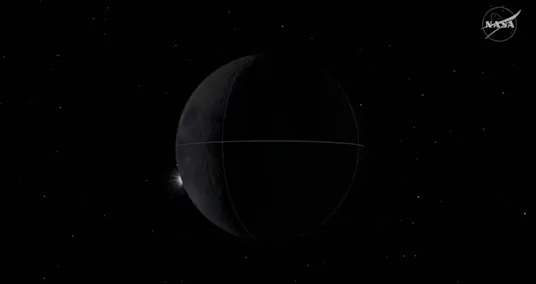
The quartet will see a total solar eclipse that evening as they slingshot around the moon's far side, in a flyby that breaks humanity's all-time distance record.
And that eclipse will be something that none of us stuck on terra firma have ever seen. (And, to be clear, groundbound viewers won't see this one; it will be visible only to the Artemis 2 crew.)
"From our vantage point, the moon and the sun in the sky appear approximately the same size," NASA's Kelsey Young, Artemis science flight operations lead, said during a press conference on Saturday (April 4).
But Artemis 2's Orion capsule "has a much different view than we do," she added. "And so the moon appears much, much, much larger in their view than it does from us here on Earth."
As a result, the sun will disappear from Artemis 2's view for about 53 minutes on Monday — about seven times longer than the maximum period of totality possible for eclipses seen from Earth.
Artemis 2's total solar eclipse will begin Monday at about 8:35 p.m. EDT (0035 GMT on April 7), 90 minutes after Orion reaches its maximum distance from Earth — 252,757 miles (406,773 kilometers), which is about 4,000 miles (6,400 km) farther than NASA's Apollo 13 mission got in April 1970.
Eclipses give solar scientists a rare chance to study the sun's wispy outer atmosphere, or corona, which is usually drowned out by the overwhelming glare of the solar disk. So NASA is pressing the Artemis 2 crew into sun-watching service on Monday evening.
"We've included prompts for them to describe the features that they can see in the solar corona, which can ultimately help solar scientists understand these processes in general, especially given the unique vantage point that the crew are going to have relative to our orbiting spacecraft here on Earth and our observers, our scientists, here on Earth as well," Young said.

Such work is part of a broader flyby observation campaign, during which the four Artemis 2 astronauts — NASA's Reid Wiseman, Victor Glover and Christina Koch, and Jeremy Hansen of the Canadian Space Agency — train their sharp eyes on the moon.
And human eyes are special, Young said; they're capable of picking up nuances of shade and color that the cameras on robotic lunar orbiters can miss. She cited the example of the Apollo 17 astronauts, who noticed oddly orange regolith on the moon that eventually revealed "that volcanic processes were active on the lunar surface much more recently than we had expected before."
So the astronauts' up-close observations on Monday should be quite valuable.
"We're looking for the crew to take time during their flyby, let their eyes adjust to what they're seeing, and call out any of those subtle color nuances, especially on the parts of the far side that have never been seen before by human eyes," Young said. "And we're able to ask more intelligent questions because of what Apollo gave us and because of what those orbiting spacecraft provided to us."
Monday's skywatching event won't be unprecedented, by the way: The Apollo astronauts — who orbited the moon rather than flew by it, as Artemis 2 will do — also saw solar eclipses from lunar realms, Young said.
The eclipse campaign comes as something of an unexpected treat for the Artemis 2 astronauts, who had been targeting an early February launch. Minor issues with their Space Launch System rocket pushed things back a bit, however, into a window that allows them to see a celestial spectacle.
"That's something that we hadn't been thinking we were going to be able to do," Hansen said on Saturday, during an interview with Canadian media. "But because we launched on April 1 — the birthday of the Royal Canadian Air Force, I'll just add in there — we're going to get to see that now, which is pretty neat."
Monday's lunar flyby will send Artemis 2 back toward Earth. The astronauts will splash down on Friday (April 10) off the coast of San Diego, bringing their 10-day moon mission to an end.

The only Lego Technic NASA Artemis Space Launch System Rocket, once built it can 'launch' thanks to the clever Technic engineering mechanisms inside. It stands 27.5-inches (70 cm) tall but is made from only 632 pieces, making this suitable for ages 9+, compared with the adult-oriented (and $260) static Lego Icons NASA Artemis Space Launch System (10341) model.
LATEST POSTS
- 1
 The most effective method to Succeed in Your Profession with a Web based Advertising Degree
- 2Building Tough Connections: Individual Bits of knowledge on Association
- 3Misjudged Objections For Solo Voyagers
- 4Zelensky warns of imminent massive Russian attack on Ukraine
- 5Disability rights activist and author Alice Wong dies at 51


- 12 times rockets and spacecraft crashed and burned in 2025
- How federal officials talk about health is shifting in troubling ways – and that change makes me worried for my autistic child
- Game theory explains why reasonable parents make vaccine choices that fuel outbreaks
- 'Dancing With the Stars' Season 34 finale: Who might win the mirror ball trophy? Where do the remaining contestants rank?
- Taylor Swift's 'The End of an Era' docuseries: Everything you need to know, plus how to watch for less
- Help Your Efficiency: 10 Authoritative Apparatuses to Attempt
- Cannabis reclassification could 'open the floodgates' for research, scientists say
- Cyber Monday 2025 streaming deal: Get $42 off six months of Apple TV
- Mexico says a third of 130,000 missing people might be alive, fueling criticisms by families