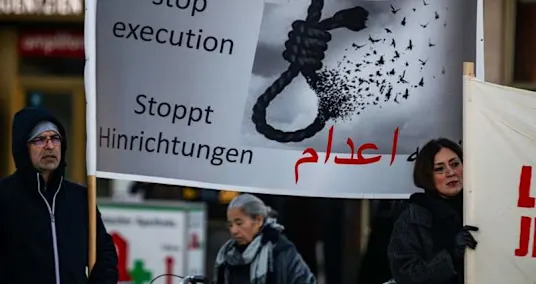
Two of those executed on Monday were killed without advance notice, denying them the chance to meet with their lawyers or say goodbye to their families, according to Amnesty International.
Iran executed two men tied to the People’s Mojahedin Organisation of Iran (PMOI), adding to two other men who were executed on Monday, the group said on Tuesday, confirming a report by Iran’s judiciary news outlet.
PMOI members, 34-year-old law school graduate Babak Alipour and 33-year-old electrical engineer Pouya Ghobadi, were killed on Monday after being convicted of links to the outlawed group and for alleged involvement in multiple attacks, including firing launcher weapons at a government building, according to the judiciary outlet.
Akbar Daneshvarkar, 60, and Mohammad Taghavi-Sangdehi, 59, were also hanged on Monday for alleged membership in Mujahideen-e-Khalq.
Daneshvarkar and Sangdehi were killed without advance notice, denying them the chance to meet with their lawyers or say goodbye to their families, according to Amnesty International.

Abolhassan Montazer and Vahid Bani Amerian, who were tried in the same case, are at imminent risk of death, and communication with the men has so far been impossible to establish, the NGO warned, adding that sources indicated all were subjected to torture during their detention.
“They were chivalrous men who did not bow to any torture or pressure and stood firm on their pledge and covenant until the very end,” Maryam Rajavi, president-elect of the Paris-based National Council of Resistance of Iran (NCRI), the political arm of the PMOI, said in a statement confirming the executions.
She said a number of PMOI members and other political prisoners remained on death row and called for international action to be taken to save their lives.
People’s Mojahedin Organisation banned in Iran
The NCRI, also known as PMOI, is banned in Iran, and it is unclear how much support it has there. However, along with its bitter rival – the monarchists backing Reza Pahlavi, exiled son of the toppled Shah – it is one of the few opposition groups able to rally supporters.
United Nations Special Rapporteur on human rights in Iran warned on Tuesday that, while the internet shutdown had made it difficult to monitor executions, it was “clear” the regime is using executions as “a means of suppressing political dissent amid war.”
United Nations Special Rapporteur on Human Rights and Counter Terrorism Professor Ben Saul added that he also condemned “Iran’s misuse of the death penalty in alleged security cases in violation of the right to life.”
LATEST POSTS
- 1
 Parents who delay baby's first vaccines also likely to skip measles shots
- 2How a Snake That Eats Cobras Redefined the Meaning of ‘King’
- 3Why boosting production of Venezuela's 'very dense, very sloppy' oil could harm the environment
- 4Some are walking out. Some are shouting. Some are oblivious. How kids are reacting to THAT 'Wicked: For Good' scene
- 5Upgrading the Healthy benefit of Your Local Vegetables


- 5 Destinations Where Airfare Is Dropping The Most For Spring 2026, Per Dollar Flight Club Analysis
- Dental, Vision, and Hearing Inclusion in Senior Protection.
- Beddings of 2024: Track down Your Ideal Fit for a Tranquil Rest
- Does physics say that free will doesn't exist?
- The Best Web-based Courses for Expertise Improvement
- New peace laureate: Iran's arrest of Mohammadi 'confession of fear'
- Report: Russian military pressuring students to work as drone pilots
- 10 Asian Countries Perfect for Solo Female Travelers
- My Enterprising Excursion: Building a Startup