When you buy through links on our articles, Future and its syndication partners may earn a commission.

HOUSTON — NASA's first astronaut close encounter with the moon in over 50 years will become a reality today (April 6), and you'll be able to follow it live online. But you will need to know when to tune in and for how long, and for that, we've got you covered.
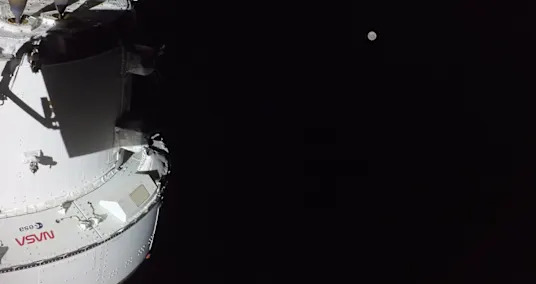
The four astronauts of NASA's Artemis 2 mission will fly around the moon today in a seven-hour flyby that will begin at 1:30 p.m. EDT (1730 GMT), but the crew has already captured stunning views of Earth's neighbor over the last few days. You'll be able to watch the moon flyby live on Space.com, courtesy of NASA, and follow the flyby as it happens on our Artemis 2 mission updates page.
"The four of us have looked at the moon our entire lives, and the way we are responding to what we're seeing out the window is just like we're a bunch of kids up here," Artemis 2 commander Reid Wiseman radioed to Mission Control late Sunday (April 5). "We cannot get enough of this. It's amazing."

Wiseman and his Artemis 2 crewmates — pilot Victor Glover and mission specialists Christina Koch and Jeremy Hansen — will be the first humans to see the moon up close since NASA's Apollo 17 mission in 1972.
They are the first astronauts to visit the moon in the 21st century, and they will see parts of the moon that NASA's Apollo astronauts were never able to, like the poles of the far side. They'll also see a rare solar eclipse from beyond the moon.
To help you know what to expect, here's a timeline of NASA's Artemis 2 moon flyby day, hour by hour.

Kelsey Young, Artemis 2 lunar science lead, said NASA has 10 science objectives and 35 different targets for the Artemis 2 crew to aim for during the flyby.
The astronauts will work in two-person shifts over five hours of the main flyby period. They'll use a tablet-based Lunar Targeting Plan app to record voice observations of their targets while also taking potentially thousands of photos of moon craters, plains and mountains.
"We've got a jam-packed plan for them tomorrow, and it ultimately all traces down to our objectives," Young said.
The astronauts have had several opportunities to observe the moon as they closed in on their lunar flyby. Based on their descriptions of the moon, NASA's lunar science team can't wait to hear the Artemis 2 crew's observations from today's flyby.
"They crushed it," said Jennifer Hellmann, an Artemis 2 science team lead from NASA's Ames Research Center in California. "We were excited for the flyby before, don't get me wrong. But we are, like, super, super excited now because they're so good! They're so well trained; they know what they're talking about."

The only Lego Technic NASA Artemis Space Launch System Rocket, once built it can 'launch' thanks to the clever Technic engineering mechanisms inside. It stands 27.5-inches (70 cm) tall but is made from only 632 pieces, making this suitable for ages 9+, compared with the adult-oriented (and $260) static Lego Icons NASA Artemis Space Launch System (10341) model.
LATEST POSTS
- 1
 Flourishing in Retirement: Individual Accounts of Post-Vocation Satisfaction
- 2'It's doing badly': Fears grow for whale stuck off Germany's coast
- 3Moldova says Russian drones violated airspace
- 4Reporter's notebook: Inside the IDF’s ‘Hamas Village,’ and how Israel is rewriting urban warfare
- 5'Outrageous and illegal' : UNRWA slams Israel for cutting off its water, comms and electric in Gaza




- Role reversal: Ukraine moves training home and exports the lessons abroad
- How one man's concern saved his brothers from heart disease
- Pfizer says patient dies after receiving hemophilia drug in trial
- Step by step instructions to Safeguard Your Teeth During Sports Exercises
- Soldiers seize power in Guinea-Bissau and detain the president
- 'Home Alone' actor Joe Pesci said 'no' to this stunt until he saw a 9-year-old girl do it, says director Chris Columbus
- Kelsey Grammer on having a new baby at 70: 'You're just more available now'
- Step by step instructions to Look at Compact disc Rates: A Thorough Aide
- January’s full wolf supermoon and the Quadrantid meteor shower will start off the new year