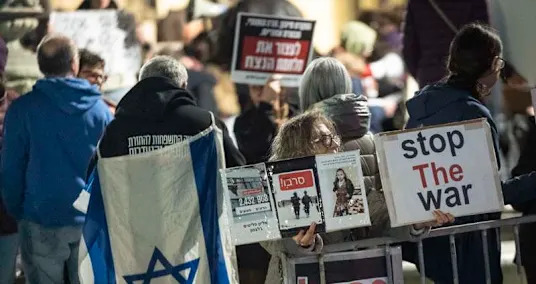
Demonstrators carried signs reading “We must stop” and “Bibi will kill us all,” while about 200 people gathered at Horev Junction in Haifa.
Anti-war demonstrations were held across Israel on Saturday evening, with protesters gathering in Tel Aviv, Haifa, Jerusalem, and Kfar Saba despite strict wartime restrictions on public assembly.
Demonstrators carried signs reading “We must stop” and “Bibi will kill us all,” while about 200 people gathered at Horev Junction in Haifa.
Earlier on Saturday, the Home Front Command granted an exceptional permit for a protest of up to 150 people at Habima Square in Tel Aviv, after state authorities told the High Court of Justice that demonstrations would be allowed only in a limited format and under tight attendance caps.
The Association for Civil Rights in Israel sought an urgent hearing, arguing that the restrictions harm the right to protest.

Security restrictions and court dispute
One IDF officer said the Home Front Command examined each requested protest site individually on operational, professional, and security grounds, including proximity to protected spaces. As a result, authorities did not approve a large gathering at Habima Square and instead allowed only 50 to 150 participants near a shelter.
The officer said the military declined to provide further details on all of its security considerations, but offered to present them to the court in a closed session.
“We are acting professionally and objectively. There is no political consideration here or any other consideration,” he said.
The requests covered several locations, including Habima Square in Tel Aviv, Horev Center in Haifa, Paris Square in Jerusalem, and Weizmann Street in Kfar Saba. In Tel Aviv, the state told the Supreme Court that the protest could proceed in two separate groups of up to 75 people each, for a total of 150 participants.
Protest groups push back
Police and the Home Front Command said the limits stemmed from operational and security concerns, against the backdrop of fears of missile fire and broader wartime restrictions on gatherings.
Civil rights lawyers, however, argued in court that earlier judicial remarks on the importance of political free expression during wartime had not been meaningfully implemented.
The dispute followed a tense High Court hearing on Friday, during which Supreme Court President Isaac Amit sharply criticized the state’s position.
The judges stressed that the right to protest does not disappear during war and said police should propose a framework that would allow demonstrations to proceed.
LATEST POSTS
- 1
 How mountain terraces have helped Indigenous peoples live with climate uncertainty
 - 2How to watch 2026 Golden Globe winners like 'One Battle After Another,' 'Adolescence' and 'The Pitt'
- 3Staggering Spots to Stargaze All over the Planet
- 4Well informed: How to Take full advantage of Your Gadgets
- 5Ministry: New German petrol price regulation takes effect on April 1


- How did I get my own unique set of fingerprints?
- General Atlantic says ‘biggest mistake’ would be pulling back on Gulf deals
- Top 10 Moving Style Architects of the Year
- India’s delayed climate plan sets modest emission target
- The Significance of Prenuptial Arrangements in Separation Procedures
- Orcas seen hunting great white sharks to eat their livers in drone footage recorded in Mexico
- ‘Integral part of our nation’: Herzog visits Franciscan Sisters in Jerusalem ahead of Christmas
- What are the health benefits of whole milk for kids?
- Dark matter may be made of pieces of giant, exotic objects — and astronomers think they know how to look for them